
What Shapes Fellowship Pursuits in Dermatology
Interest in pursuing fellowship training among dermatology residents remains high, with 22.4% of residents indicating plans to subspecialize in 2022.1 This trend is expected to continue, particularly in procedural fellowships such as Mohs surgery. Shortages persist in pediatric dermatology and dermatology-trained dermatopathology, as only 371 pediatric dermatologists practice nationally and nearly a quarter of residency programs lack a dermatology-trained dermatopathologist.2,3 Quantifying resident subspecialty interest and identifying factors influencing fellowship decision making are important for workforce planning and recruitment.
We distributed a national survey via the Association of Professors of Dermatology and directly to 197 residency programs, opening in November 2024 and closing January 2025. The survey included demographics and 15 predefined influences on fellowship decisions. The data underlying this article have not been published but will be shared upon reasonable request to the corresponding author at EDHicks@uams.edu.
A total of 86 residents responded. Most were female (67.4%), 35 years of age or younger (91.9%), and trained in academic centers (96.5%). Participants were geographically diverse, with the Midwest most represented (39.5%). Fellowship intentions were split: 41.9% planned to pursue, 41.9% did not, and 16.3% were unsure. Most reported deciding during residency (65.9%). Demographic data are presented in Table 1. Among those planning to pursue fellowship who completed all 15 factor questions, Mohs surgery (35.7%), dermatopathology (32.1%), and pediatric dermatology (28.6%) predominated regarding fellowships of interest. Fifty-three total residents completed all questions exploring factors.

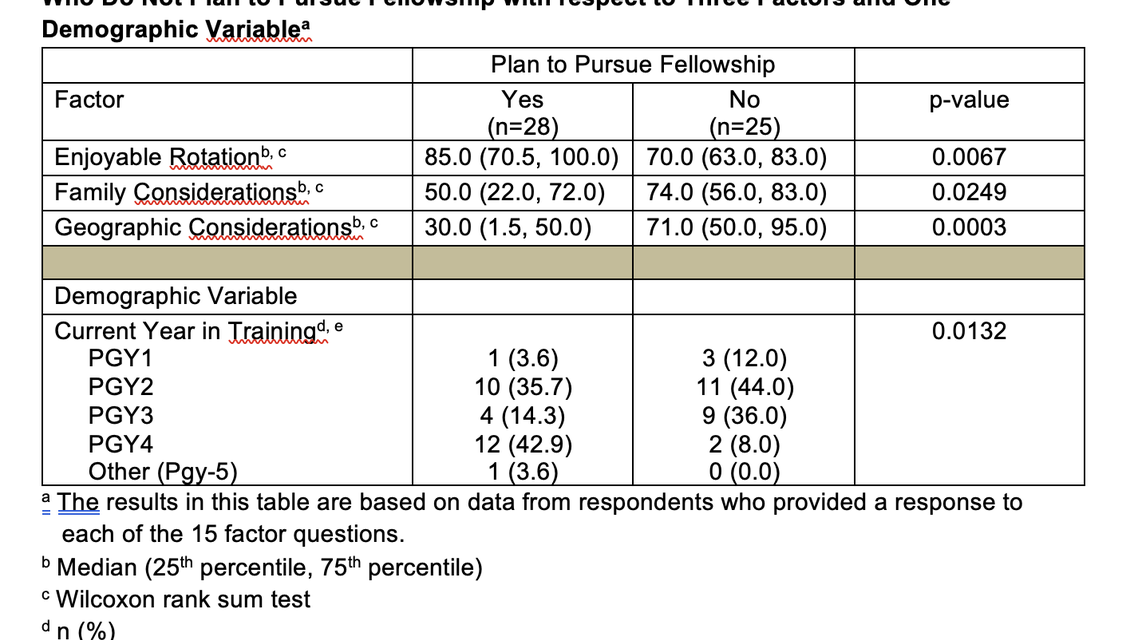
Residents planning to pursue fellowship and who answered all 15 factor questions identified strong personal interest, enjoyable rotation, work hours, and mentorship as the most influential factors, with family, research, geography, and desire to join a specific group/practice ranked lowest (Figure 1). Like residents planning to pursue fellowship, residents not planning to pursue fellowship and who answered all 15 factor questions identified strong personal interest as the most influential factor but identified family considerations, patient contact, and geography as the next three most influential factors while little or no call responsibility, reputation/prestige of the program, desire to join a specific group/practice, and research opportunities were ranked lowest (Figure 2). There was sufficient evidence to suggest that three factors differed significantly statistically between cohorts (enjoyable rotation, p=0.0067; family considerations, p=0.0249; and geographic considerations, p=0.0003). It appears that enjoyable rotation tends to be ranked higher by residents who plan to pursue fellowship, while family and geographic considerations tend to be ranked lower compared to residents who do not plan to pursue fellowship (Table 2). These findings underscore how mentorship and positive clinical experiences may weigh heavily for those pursuing subspecialization, while family considerations and location may strongly influence those opting against fellowship.


The decision to pursue dermatology fellowship training is multifactorial and mirrors findings in other specialties. Radiology residents consistently cite personal interest, enjoyable rotation, and job security as key drivers.4 A survey of dermatology residents in Saudi Arabia likewise identified quality of life and earning potential as major considerations.5 Our study adds to this literature by quantifying a possible increase in fellowship interest amongst surveyed US dermatology residents and by identifying notable factors that currently may contribute to this decision.
The percentage of dermatology residents who plan to pursue fellowship training that we observed (41.9%) exceeds prior reporting of 22.4%, suggesting a possible shift toward subspecialization in US dermatology. Alternatively, selection bias may have resulted in residents more interested in fellowship being more likely to respond to the survey. Notably, among respondents who indicated they plan to pursue fellowship and who answered all 15 factor questions, more than one-fourth expressed interest in pediatric dermatology, a field currently experiencing a significant workforce shortage. The growing interest in pediatric dermatology may reflect effective mentorship and recruitment strategies or a preference for academic practice. However, the persistence of geographic and family-related barriers may indicate that certain residents may be unable to pursue fellowship despite interest. Tailored strategies, such as offering flexible training pathways, expanding regional fellowships, or enhancing the clinical experience, may help align resident interest with workforce needs.
For residents not planning to pursue fellowship, family and geographic considerations were among top priorities. Financial considerations also ranked higher for those residents compared to peers planning to pursue fellowship, consistent with the perception that fellowship represents a financial sacrifice of an additional training year. Lower rankings for mentorship and enjoyable rotation among this group may suggest that limited mentorship from a fellowship-trained dermatologist or subspecialty exposure may reinforce decisions to enter general dermatology practice and forgo fellowship training. It may also suggest, for certain residents, that the decision to forgo fellowship is largely independent of mentor influence and that personal factors are more significant when making this decision. These differences highlight modifiable program-level factors that could increase fellowship recruitment in shortage areas.
LIMITATIONS
This study has several limitations. First, the modest sample size and low response rate limit generalizability. Second, social desirability bias may have influenced responses, particularly regarding financial considerations. Respondents may be less likely to report financial motivations due to financial stigmatization. Third, restricting the survey to 15 predefined factors may have excluded other relevant motivators, such as long-term career aspirations or exposure to underserved populations. Lastly, a selection bias may exist. Residents interested in fellowship may be more likely to respond to a survey about fellowship. Nonetheless, the integration of ranking data with statistical comparisons strengthens the interpretability of the findings.
CONCLUSION
Dermatology residents planning to pursue fellowship are motivated by personal interest, enjoyable rotation, and work hours, while those not planning to pursue fellowship prioritize personal interest, family considerations, and patient contact, as well as geography. Statistically significant differences in enjoyable rotation, family considerations, and geography can help fellowship program directors and professional organizations design targeted strategies to recruit residents into undersupplied subspecialties, particularly pediatric dermatology.
Acknowledgments: Support was provided by the Translational Research Institute. The Translational Research Institute’s CTSA funding did not directly support the work reported in this article.
- Ahmad AS, Mulligan KM, Zheng DX, O'Connell KA, Gallo Marin B, Koshelev MV. The current state of fellowship leadership in dermatology: trends in workforce demographics and scholarly productivity. Clin Exp Dermatol. 2023;48(5):538-540. doi:10.1093/ced/llad011
- Lee S, Aigbekaen I, Huang J. Geographic Maldistribution of Pediatric Dermatologists in Relation to Pediatric and Family Medicine Residency Programs. Acad Pediatr. 2025;25(6):102835. doi:10.1016/j.acap.2025.102835
- Fagan EF, McGrath JT, Sharma D, Thomas S, Georgesen C, Wei EX. Analysis of current dermatopathology training across U.S. residency programs. Arch Dermatol Res. 2025;317(1):724. Published 2025 Apr 19. doi:10.1007/s00403-025-04185-z
- Hicks ED, Heft ME, Hameed MY, et al. Factors for which radiology residents choose fellowship. Curr Probl Diagn Radiol. 2024;53(4):499-502. doi:10.1067/j.cpradiol.2024.01.025
- Alakeel A, Alhedaithi I, Shadid A, Algarni A, Alekrish Y, Alekrish K. Factors that influence dermatology residents' choice of future subspecialty: A cross-sectional study. J Educ Health Promot. 2024;13:322. Published 2024 Aug 29. doi:10.4103/jehp.jehp_1398_23
Ready to Claim Your Credits?
You have attempts to pass this post-test. Take your time and review carefully before submitting.
Good luck!
Recommended
 Practice Management
The Art of Marketing Dynamic Teledermatology and Artificial Intelligence Solutions
Naren ArulrajahNaren Arulrajah