
Mohs Micrographic Surgery Access and Distribution Lacking in Louisiana
Mohs micrographic surgery (MMS) is a more precise, tissue-preserving surgical technique for certain skin cancers if they meet appropriate use criteria. MMS provides high cure rates for a variety of skin cancers, most commonly basal cell carcinomas and squamous cell carcinomas. The advantage of MMS is that it allows surgeons to evaluate the tumor margins microscopically, ensuring higher chances of complete removal of the cancer while preserving as much healthy tissue as possible.1
With the increasing incidence of skin cancer, access to MMS is important for optimal patient outcomes. Across the United States, the distribution of MMS surgeons correlates with population density. As a result, many rural populations have little to no access to MMS unless they are willing to traverse longer distances.2 Louisiana faces similar challenges because it is a predominantly rural state with significant disparities in healthcare access. Rural residents often face long travel distances for medical care, often delaying diagnosis and treatment; longer distances to care have been correlated to poorer health outcomes.3 Further, there are significant variations and disparities in distribution of general dermatologists who refer these patients in Louisiana; New Orleans, Baton Rouge, and southeast Louisiana overall have a significantly higher concentration of dermatologists and ratio of dermatologists per patient than the central or northern portion of the state. Given these barriers, evaluating access to specialized dermatologic care is important. This study evaluates Medicaid acceptance, geographic distribution and access to MMS across the state of Louisiana.
METHODS
A cross-sectional descriptive analysis was performed to evaluate the geographic distribution of Mohs surgeons in Louisiana. Mohs surgeons were identified using the American College of Mohs Surgery (ACMS) and publicly available practice websites.4 Both fellowship-trained surgeons and surgeons certified in Micrographic Dermatologic Surgery (MDS) through the American Board of Dermatology (ABD) were included. Prior to 2025, the ABD MDS certification pathway allowed dermatologists who had demonstrated significant experience and competency in MMS to obtain subspecialty certification without completing an ACMS fellowship. All physicians included in this study were verified to hold MDS certification through the ABD.5 To confirm Medicaid acceptance, each office was directly contacted to verify this information. Louisiana has a large population on Medicaid. Identifying Mohs surgeons who accept this insurance is important when evaluating true access to care for rural and vulnerable populations.
Physicians were assigned to Louisiana parishes according to their listed primary practice location (only primary sites were used for density calculations to prevent duplicate counting). To better assess access to care, secondary practice locations were also collected and mapped separately. Parish populations were obtained using the U.S. Census Bureau.6 Mohs surgeon density was calculated for parishes with a primary practice location using the following formula: Mohs surgeon density = (number of Mohs surgeons/parish population) x 100,000 residents. All 64 parishes in Louisiana were evaluated and compared. Descriptive statistics were used to summarize the distribution of Mohs surgeons as well as the parishes without surgeons. To visually show these findings, primary and secondary locations were displayed using parish-level maps to highlight geographic patterns.
RESULTS
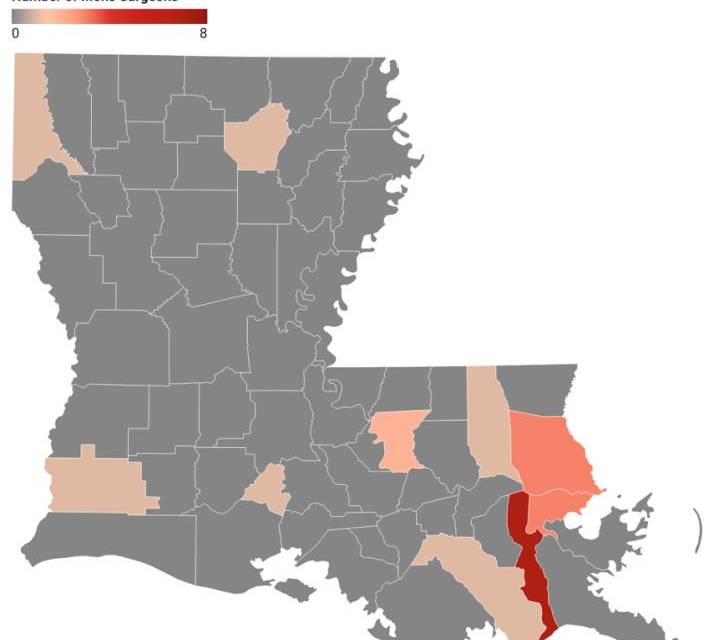
A total of 21 Mohs surgeons were identified in Louisiana with primary practice locations in 10 of the state’s 64 parishes (15.6%). That leaves a total of 54 parishes (84.4%) without a primary Mohs surgeon. Based on the 2020 U.S. Census parish population estimates, approximately 2,024,160 residents live in parishes without direct access to a primary Mohs surgeon. Mohs surgeons are mostly concentrated in a small number of urban and suburban parishes (Figure 1 and Table 1).
Jefferson Parish had the highest number (7 surgeons), followed by Orleans Parish (3), St. Tammany Parish (3) and East Baton Rouge Parish (2). When standardized by population, Mohs surgeon density ranged from 0.41 to 1.59 surgeons per 100,000 residents among parishes with at least 1 surgeon.
Jefferson Parish had the highest density (1.59), followed by St. Tammany Parish (1.13) and Lafourche Parish (1.03). The overall statewide density of Mohs surgeons for Louisiana is approximately 0.45 surgeons per 100,000 residents. Of the 21 Mohs surgeons, 6 (28.6%) accept Medicaid as a primary insurance, and are all located in southeast Louisiana. No Mohs surgeons accepting Medicaid were identified in other regions of the state.
Table 1. Density of Mohs surgeons in Louisiana based on primary practice locations. Mohs surgeon density was calculated as the number of surgeons per 100,000 residents using the 2020 U.S. Census parish population estimates. Parishes with no Mohs surgeons were not counted. |
Mohs Surgeons | Population | Mohs Surgeons per 100,000 | |
Jefferson | 7 | 440,781 | 1.59 |
Orleans | 3 | 383,997 | 0.78 |
St. Tammany | 3 | 264,570 | 1.13 |
Lafourche | 1 | 97,557 | 1.03 |
Tangipahoa | 1 | 133,157 | 0.75 |
Ouachita | 1 | 160,368 | 0.62 |
Calcasieu | 1 | 216,785 | 0.46 |
East Baton Rouge | 2 | 456,781 | 0.44 |
Caddo | 1 | 237,848 | 0.42 |
Lafayette | 1 | 241,753 | 0.41 |
Statewide Total | 21 | 4,657,757 | 0.45 |


Figures 1 and 2. Color intensity represents the number of Mohs surgeons per parish. Gray indicates parishes without a Mohs surgeon.
To better represent the geographic reach of Mohs surgeons in Louisiana, a second map including both primary and secondary offices was created (Figure 2). When secondary locations were included, the number of parishes increases slightly. Rapides Parish in central Louisiana demonstrated notable expanded coverage, with four surgeons providing services through secondary practice locations. One surgeon travels from Lafayette; one from Little Rock, Arkansas; and two from Illinois. Despite the expanded coverage, it is clear to see that majority of Louisiana parishes remain without local access to Mohs surgical services, particularly across large portions of central and north Louisiana (Figure 1).
CONCLUSIONS
The findings of this study highlight significant disparities in access and distribution of MMS in Louisiana. The statewide density of Mohs surgeons is 0.45 per 100,000 residents, which is far less than the estimated United States density of 0.8 Mohs surgeons per 100,000 residents based on the Centers for Medicare & Medicaid services billing analysis.2
Additionally, only 15.6% of parishes have a primary Mohs surgeon, with most located in urban and suburban regions. This leaves more than 2 million residents without direct access to a Mohs surgeon, suggesting that many patients travel long distances for treatment of Mohs-eligible skin cancers. In addition to a disproportionate geographic distribution, only 6 of the 21 identified Mohs surgeons accept Medicaid as a primary insurance, and of all of which are located in southeast Louisiana. This concentration further restricts access for lower-income populations and those who reside in other regions of the state. Limited participation among Mohs surgeons in Medicaid programs may reflect several factors reported in prior studies, including lower reimbursement rates, administrative burden, and practice resource constraints.7
The inclusion of secondary practices only slightly increases access across the state, most notably Rapides Parish. While this does improve access, these Mohs surgeons travel to secondary practices only part-time. Secondary practice sites may increase access in some areas but do not fully address the broader imbalance of specialist distribution across the state. These findings highlight the need for solutions aimed at improving specialist distribution, recruiting more Mohs surgeons to Louisiana, and expanding access to the standard of care treatment for many skin cancers.
- Prickett KA, Ramsey ML. Mohs micrographic surgery. In: StatPearls. StatPearls Publishing; updated July 25, 2023. Accessed March 2026. https://www.ncbi.nlm.nih.gov/books/NBK441833/
- Ahn JW, et al. Defining Mohs micrographic surgery workforce: a cross-sectional analysis of Centers for Medicare and Medicaid Services Current Procedural Terminology code 17311 billing from 2015 to 2020. J Am Acad Dermatol. Published online March 2023. doi:10.1016/j.jaad.2023.03.014
- Wang F, Zeng Y, Liu L, Onega T. Disparities in spatial accessibility of primary care in Louisiana: from physical to virtual accessibility. Front Public Health. 2023;11:1154574. doi:10.3389/fpubh.2023.1154574
- American College of Mohs Surgery. Find a Mohs Surgeon. Accessed March 2026. https://www.mohscollege.org
- American Board of Dermatology. Micrographic Dermatologic Surgery (MDS) Certification Verification. Accessed March 2026. https://www.abderm.org
- U.S. Census Bureau. Louisiana. Accessed March 8, 2026. https://www.census.gov/library/stories/state-by-state/louisiana.html
- Neprash HT, Zink A, Gray J, Hempstead K. Physicians' participation in Medicaid increased only slightly following expansion. Health Aff (Millwood). 2018;37(7):1087-1091. doi:10.1377/hlthaff.2017.1085
Ready to Claim Your Credits?
You have attempts to pass this post-test. Take your time and review carefully before submitting.
Good luck!
Recommended
 Skin Cancer & Photoprotection
Evidence, Techniques, and a Standardized 5-Fluorouracil Protocol for Intralesional Therapies Treating Keratinocyte Cancers
Puneet Singh Jolly, MD; Maria D. Melendez-Gonzalez, MDPuneet Singh Jolly, MD; Maria D. Melendez-Gonzalez, MD- Skin Cancer & Photoprotection
Update on the Safety and Efficacy of Nicotinamide for Skin Cancer Chemoprevention
Sami Jelousi, MD; Lee Wheless, MD, PhDSami Jelousi, MD; Lee Wheless, MD, PhD - Skin Cancer & Photoprotection
Tips for Management of Cutaneous Squamous Cell Carcinoma
Amanda Stines, CCMA; Vishal A. Patel, MD, FAADAmanda Stines, CCMA; Vishal A. Patel, MD, FAAD